Category
Sovereign RMM: remote management without US cloud
An RMM has full access to your entire IT estate. That is precisely why this control does not belong under foreign jurisdiction. What makes an RMM genuinely sovereign — and how to recognise one.
Sovereignty is not a label but an architecture
“Made in Germany” appears on many RMM datasheets. The term only becomes meaningful when three levels are right:
- Operator sovereignty — the provider is subject to EU law, not the CLOUD Act.
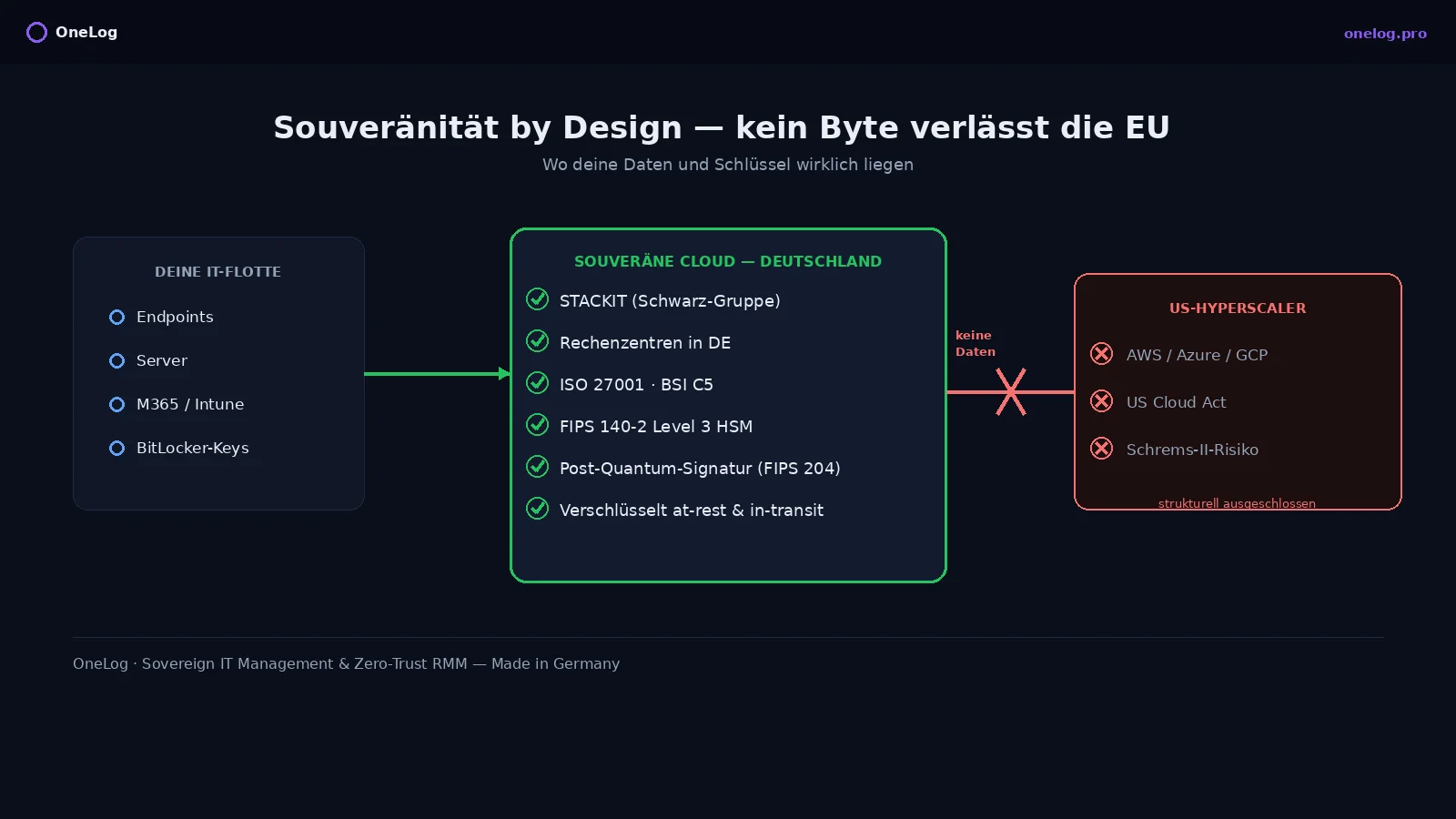
- Data sovereignty — data storage and backups remain in the EU; control of the keys remains with the customer or the EU operator.
- Operational sovereignty — support, monitoring and administration are carried out from within the EU.
Why it matters for RMM in particular
An RMM is the tool with the deepest reach into your infrastructure: it distributes patches, executes scripts and sees every asset. If this control layer falls under foreign jurisdiction, the entire estate is exposed.
OneLog as a sovereign RMM
OneLog runs in the STACKIT Sovereign Cloud, headquartered in Germany, and the EU requirements are built in from the start (NIS2). Added to this are AI agents that resolve standard tickets independently. Your data stays in Germany, with no detour via US providers — and the compliance effort serves actual protection, not just appearances.
Frequently asked questions
- What does “sovereign RMM” mean?
- An RMM whose operation, data storage and control are entirely subject to EU jurisdiction — no US cloud exposure, no CLOUD Act access, data location and support in Germany/EU.
- Is “hosting in the EU” enough for sovereignty?
- No. The ownership and operator structure is decisive too: an EU region of a US corporation may still be subject to the CLOUD Act. Sovereign means EU-operated, not merely EU-hosted.
- Is a sovereign RMM more expensive?
- Not necessarily. Sovereignty is primarily an architecture and operator decision. OneLog relies on transparent pricing without aggressive per-device escalation.
See OneLog in your environment
Monitors and maintains your IT remotely and fixes many incidents automatically — hosted in the EU, with no dependency on US cloud providers. NIS2 requirements are built in from the start.