Feature
Autonomous remediation: AI agents resolve tickets end-to-end
Most RMMs generate alerts — and leave the resolution to the operator. OneLog goes a step further: AI agents work through defined incidents independently, with a measured success rate and a degree of autonomy you set yourself per environment.
From alert to resolution — without an operator in between
Conventional RMMs are good at detecting: a service hangs, a patch is missing, a disk is filling up. What happens next is manual work. The operator reads the ticket, diagnoses, runs a script and closes the case. For recurring standard incidents, that is expensive routine.
OneLog reverses this sequence. For defined incident classes, AI agents take over the complete path — detection, diagnosis, action, verification — and close the ticket themselves. The operator is only brought in for what genuinely needs a decision.
The Autonomy Mode: control in four levels
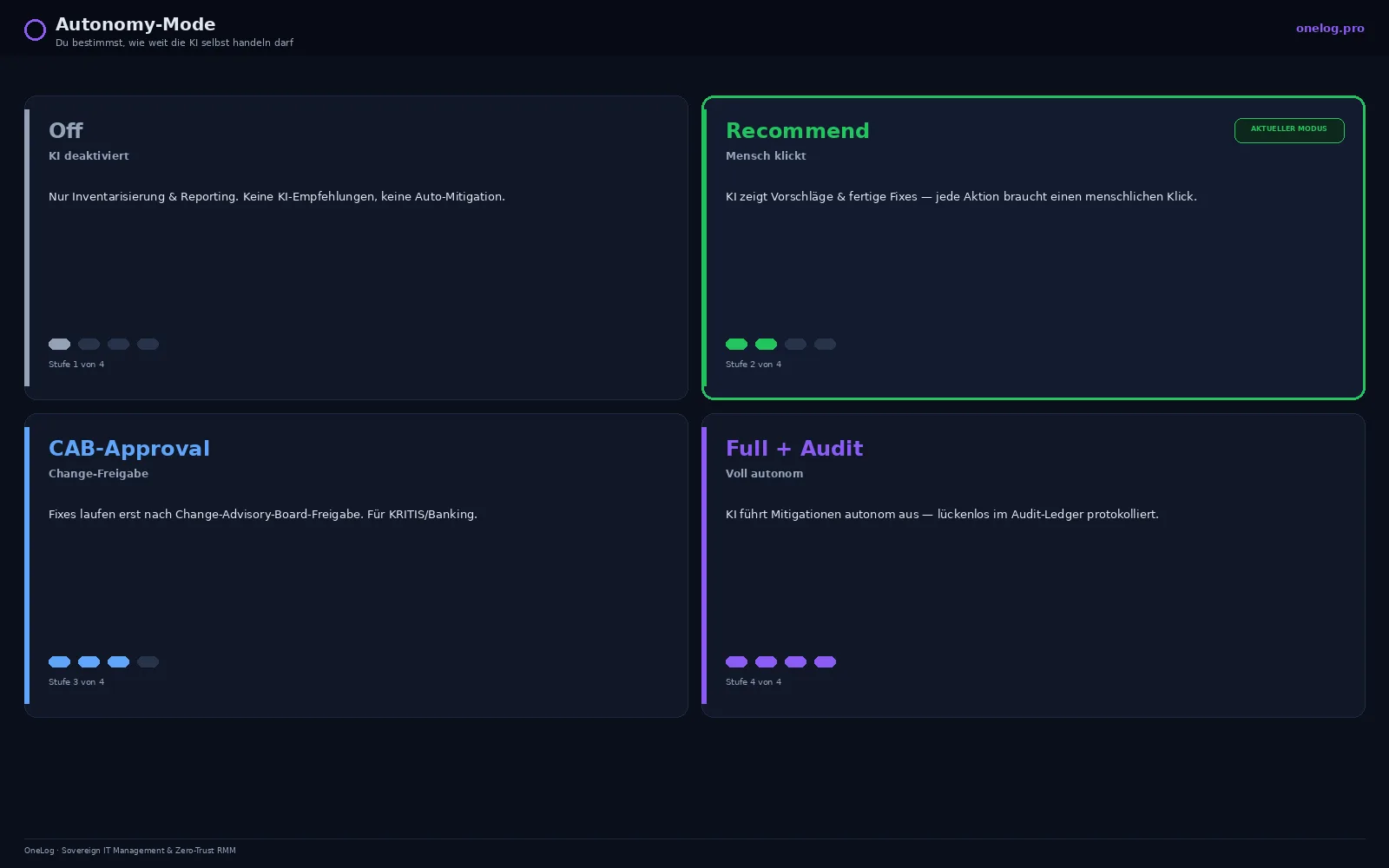
Autonomy is not all-or-nothing. In OneLog, you set the degree per environment:
- Off — the agent remains passive; you continue to work manually as before.
- Recommend — the agent diagnoses and proposes the action; a human executes it.
- CAB Approval — the agent is ready to act but waits for approval from the change advisory board.
- Full + Audit — the agent acts independently; every step is logged completely and in an auditable way.
This allows trust to be built up step by step: observe first, then approve, then let it run — and separately for each environment. A test tenant may go further than the production environment of a KRITIS (German critical infrastructure) operator.
A measured success rate instead of promises
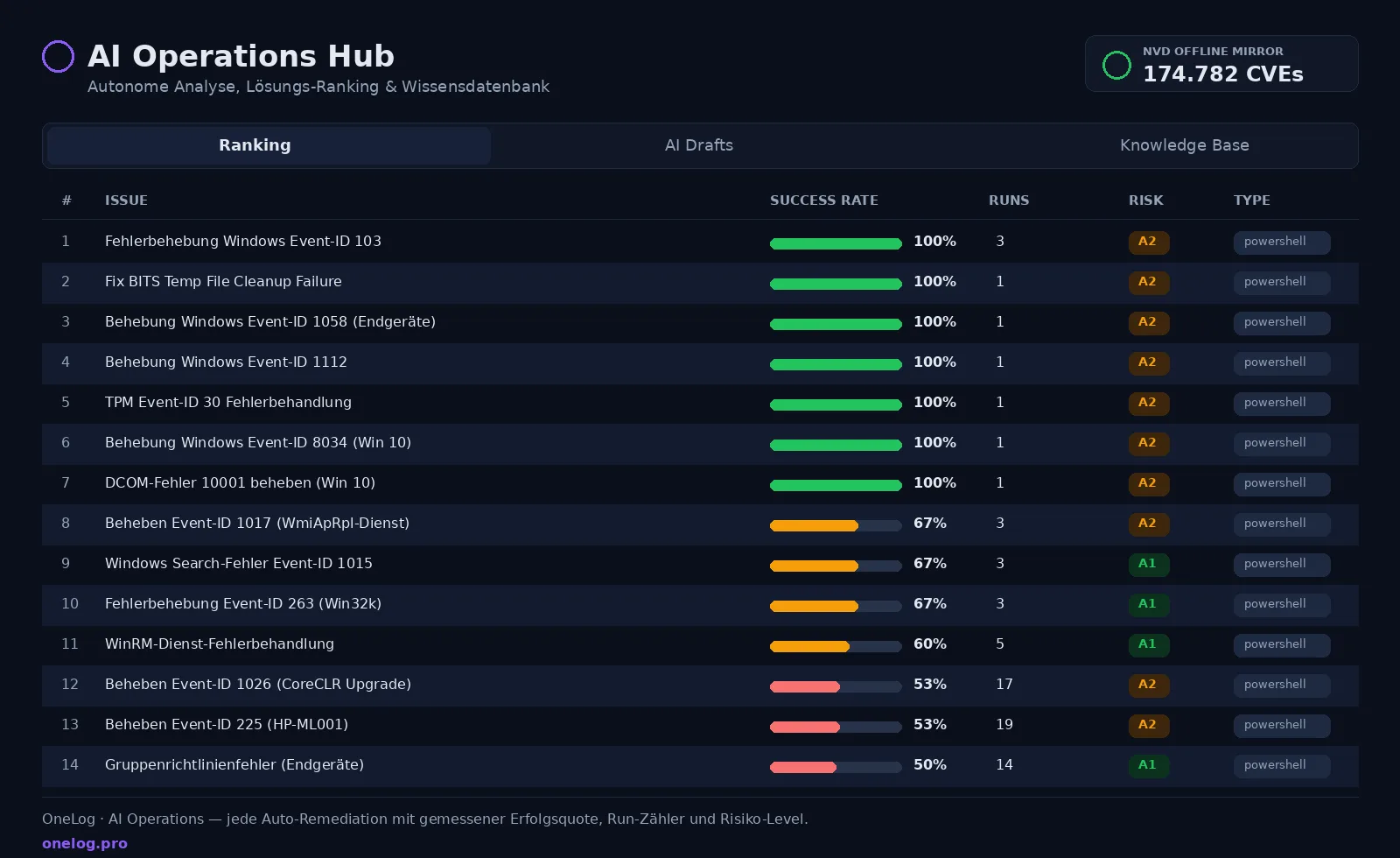
Automation is only worth as much as its reliability. That is why, in the AI Operations Hub, every remediation carries a measured success rate — derived from actual runs, not marketing assumptions. Added to this are a run counter and a risk level per workflow.
That turns the transition between autonomy levels into a data-driven decision: a remediation that performs stably over hundreds of runs can be raised from CAB Approval to Full. A new or uncertain one stays in Recommend mode until the numbers are right.
Why this holds up in regulated environments
Autonomy and verifiability are not a contradiction — provided the tool is designed for it:
- Fit for change management. CAB Approval integrates automated interventions into existing approval processes.
- Auditable. In Full mode, every run produces a complete record — who, what, when, with what result.
- Sovereignly operated. The agents run EU-sovereign in the STACKIT Sovereign Cloud, with no US cloud exposure.
In perspective
Autonomous remediation does not replace the team, but its routine burden. Standard incidents run automatically and verifiably; the team concentrates on the cases that genuinely require judgement. With the adjustable Autonomy Mode, you keep your hand on the dial at all times — from cautiously observing to fully autonomous.
Frequently asked questions
- What is autonomous remediation?
- Autonomous remediation means that AI agents work through a defined incident independently, from detection to resolution — instead of merely generating an alert that an operator has to handle manually.
- How do you keep control with autonomous remediation?
- Via the Autonomy Mode: per environment, you can set whether the agent only recommends (Recommend), obtains approval (CAB Approval) or acts fully (Full). Every run is logged in an auditable way.
- How do I know whether the automation works?
- Every remediation has a measured success rate based on previous runs. That lets you see per workflow how reliably it performs before you raise it to a higher level of autonomy.
- Can autonomous remediation be used in regulated environments too?
- Yes. Via CAB Approval and the complete audit log, the process can be integrated into change management and NIS2 evidence. OneLog is operated EU-sovereign in the STACKIT Sovereign Cloud.
See OneLog in your environment
Monitors and maintains your IT remotely and fixes many incidents automatically — hosted in the EU, with no dependency on US cloud providers. NIS2 requirements are built in from the start.